Technology is becoming an increasingly important part of modern skin health.
From digital dermoscopy to total-body photography and artificial intelligence-assisted imaging, new technologies are being explored and used to support the assessment and monitoring of skin lesions.
For patients, this raises an important question:
Can artificial intelligence detect skin cancer?
The short answer is that AI and digital imaging can assist clinicians in assessing and monitoring skin lesions, but they should not be treated as a replacement for a medical skin examination.
At AuzSkin, technology is incorporated into skin cancer assessment and monitoring alongside clinical examination by qualified medical practitioners.
What Is AI-Assisted Skin Cancer Detection?
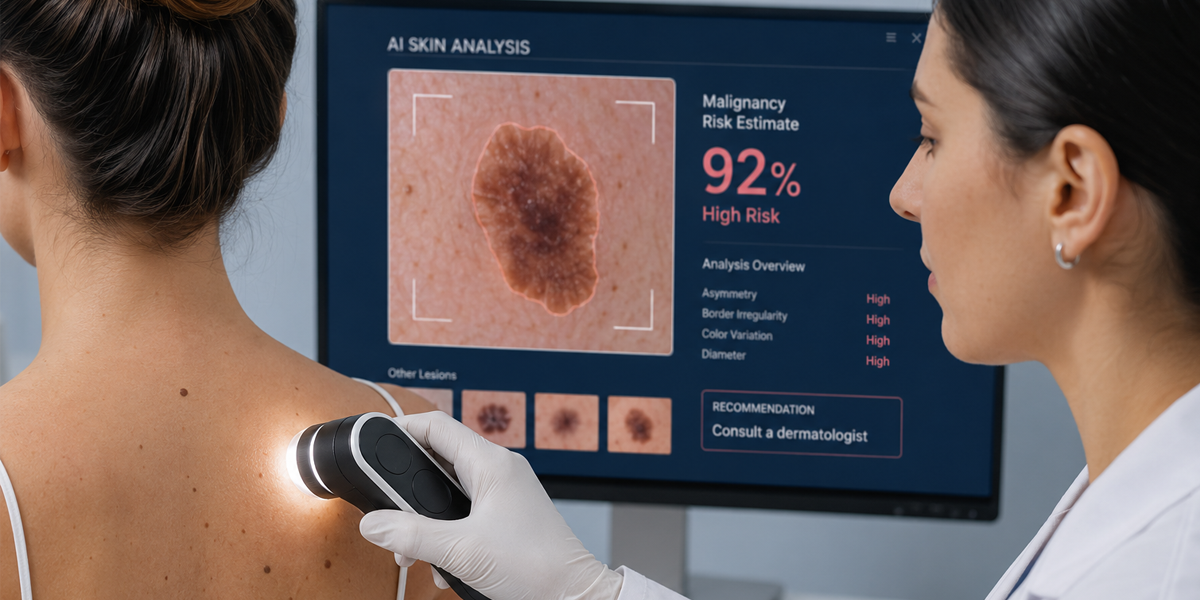
AI-assisted skin cancer detection refers to the use of computer algorithms to analyse images of skin lesions and identify visual patterns that may require further clinical attention.
Artificial intelligence can process large amounts of image data and identify patterns that may not be immediately obvious from a standard photograph.
Research into AI-assisted skin lesion analysis continues to develop, including Australian research into deep image analysis for melanoma detection.
However, an AI result is not the same as a medical diagnosis.
A skin lesion needs to be considered in the context of the person’s medical history, risk factors, physical examination and, where required, dermoscopic assessment or pathology.
How Is AI Used During a Skin Check?
AI-assisted imaging may form part of a broader skin assessment process.
A typical assessment can involve several different components.
Clinical Skin Examination
A qualified medical practitioner examines the skin and considers the appearance of individual lesions alongside your medical history and skin cancer risk factors.
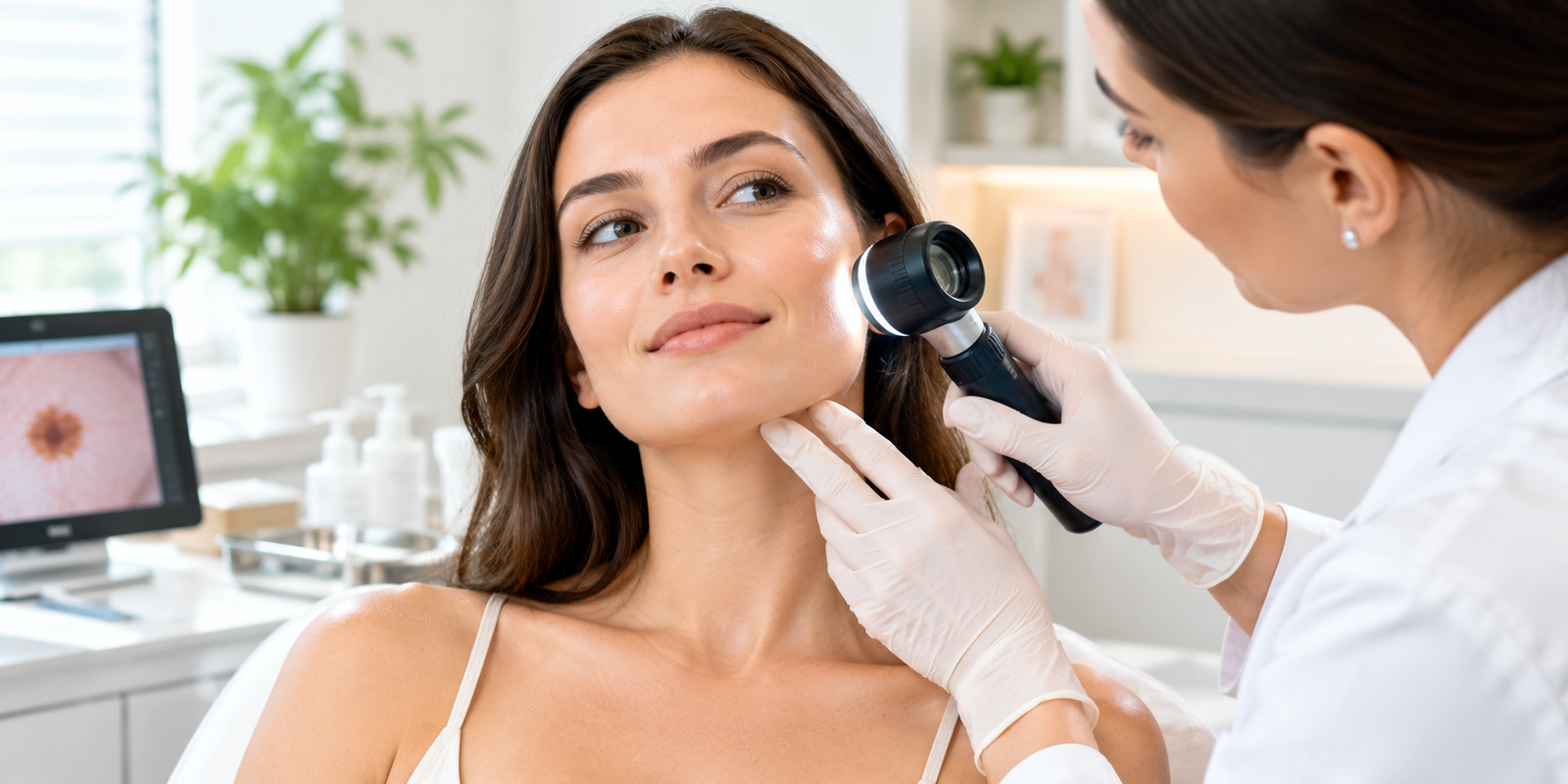
Dermoscopy
Dermoscopy uses a specialised magnifying device to provide a closer view of structures within a skin lesion that may not be visible to the naked eye.
Cancer Council Australia notes that dermoscopy can improve diagnostic accuracy when used by experienced clinicians.
Digital Imaging
Digital photography can provide a record of selected lesions or areas of the skin.
Images can then be compared during future appointments to identify changes over time.
AI-Assisted Analysis
Where available and clinically appropriate, AI-assisted imaging can provide additional information to support the assessment process.
It should be considered an additional tool rather than a standalone diagnostic method.
Can AI Diagnose Skin Cancer?
AI technology is developing rapidly, but it is important to understand its limitations.
An AI system analyses images based on patterns within the data on which it has been trained. It does not have the same role as a medical practitioner assessing a patient in person.
Cancer Council Australia does not recommend consumer smartphone applications as a substitute for examination by a doctor, noting that such applications can be inaccurate in diagnosing melanoma.
This distinction is important.
AI can assist clinical decision-making, but it should not replace clinical assessment.
If a lesion appears suspicious, further assessment may be required regardless of what an automated image analysis suggests.
Why Is Dermoscopy Still Important?
Dermoscopy remains an important tool in the assessment of skin lesions.
A dermatoscope allows a trained clinician to examine structures that are not easily visible with the naked eye.
This can help a practitioner assess both pigmented and non-pigmented lesions.
Cancer Council Australia recommends that clinicians examining skin lesions for the purpose of detecting skin cancer be trained in and use dermoscopy.
At AuzSkin, dermoscopic assessment forms part of the clinic’s skin cancer services.
What Is Digital Mole Mapping?
Digital mole mapping involves creating a photographic record of selected moles or lesions so they can be compared over time.
It can be particularly useful for people who have numerous moles or lesions that require monitoring.
AuzSkin’s mole mapping and monitoring service includes:
- Dermoscopic imaging of monitored moles
- Comparative analysis to identify changes
- Personalised risk assessment
The purpose is not simply to create photographs.
The images provide a baseline that can assist your doctor when assessing whether a lesion has changed over time.
Who May Benefit From Mole Mapping?
Mole mapping is not necessarily required for everyone.
It may be particularly useful for people who have:
- Numerous moles
- Multiple changing lesions
- A personal history of melanoma
- A family history of melanoma
- Other factors that place them at increased risk
- Lesions that require monitoring rather than immediate removal
Your doctor can assess your individual risk and determine whether digital monitoring is appropriate.
Cancer Council Australia identifies total-body photography as an additional monitoring aid, particularly for people at higher risk of melanoma, including those with a high number of naevi.
What Happens If Technology Identifies a Concerning Lesion?
If a lesion requires further investigation, your doctor may recommend additional assessment.
Depending on the lesion, this may involve:
- Further clinical examination
- Dermoscopic assessment
- Short-term or long-term monitoring
- Biopsy
- Surgical excision
A biopsy involves removing a sample of tissue for pathological examination.
Pathology can help establish whether a lesion is benign, precancerous or cancerous and can help determine appropriate management.
Why You Shouldn't Rely on an AI Skin Cancer App
There are many smartphone applications and online tools that claim to assess photographs of skin lesions.
While these technologies may appear convenient, they should not be relied upon to diagnose skin cancer.
Cancer Council Australia specifically advises against using consumer skin cancer apps as a substitute for examination by a doctor.
A photograph also cannot provide all the information a clinician may need.
A doctor can consider:
- The lesion’s appearance
- Changes over time
- Your skin type
- Your age
- Previous skin cancer
- Family history
- Sun exposure
- Other risk factors
- Findings from dermoscopy
- Whether a biopsy is required
This broader clinical context is why professional skin assessment remains important.
What Are the Benefits of Digital Skin Monitoring?
Digital monitoring can provide a useful visual record of selected lesions.
Over time, your practitioner may be able to compare images and identify changes in:
- Size
- Shape
- Colour
- Structure
- Pattern
Not every change means a lesion is cancerous, and not every suspicious lesion will necessarily change dramatically.
Your doctor will interpret the images alongside the clinical examination.
Who May Be Suitable for MiraDry?
Book a personalised aesthetic consultation at Auzskin and find treatment options tailored to your skin, age and natural features.
Does AuzSkin Use AI for Skin Cancer Checks?
AuzSkin’s current Skin Cancer Services page includes digital and AI-assisted imaging as part of its skin cancer assessment approach.
The clinic also provides:
- Skin checks
- Mole mapping and monitoring
- Dermoscopic imaging
- Personalised risk assessment
- Non-surgical skin cancer management
- Biopsies
- Surgical excisions
- Follow-up care
The technology used during your appointment depends on your individual circumstances and clinical assessment.
AI Is a Tool, Not a Diagnosis
Artificial intelligence is likely to continue influencing the way skin lesions are photographed, monitored and assessed.
Australian researchers are actively investigating advanced image analysis for melanoma and other skin conditions.
But for patients, the key point is simple:
Technology should support clinical care, not replace it.
A skin check should consider the whole patient rather than just a photograph of one lesion.
When Should You Have a Skin Check?
You should speak with a medical practitioner if you notice:
- A new mole or spot
- A mole that is changing
- A lesion that changes colour
- An irregularly shaped spot
- A sore that does not heal
- A lesion that repeatedly bleeds or crusts
- A spot that looks noticeably different from your other moles
Cancer Council Australia recommends consulting a doctor if you notice a new lesion or changes in the shape, colour or size of an existing lesion.
People with increased risk factors may also benefit from discussing an appropriate skin monitoring plan with their doctor.
AI-Assisted Skin Checks at AuzSkin
AuzSkin combines medical skin assessment with digital technology to support skin cancer monitoring and assessment.
If you have multiple moles, changing lesions or concerns about your skin cancer risk, a consultation can help determine whether dermoscopy, digital mole mapping, AI-assisted imaging or another assessment approach is appropriate for you.
Frequently Asked Questions
Can AI detect melanoma?
AI-assisted image analysis can help identify patterns in skin lesions, but it should not be treated as a standalone diagnosis. A qualified medical practitioner should assess suspicious lesions.
Is AI better than a doctor for detecting skin cancer?
AI and medical practitioners perform different roles. AI-assisted technology can provide additional information, while a medical practitioner considers the patient’s history, risk factors, examination findings and other clinical information.
What is AI skin cancer detection?
It refers to computer-based analysis of images of skin lesions to identify patterns that may warrant further clinical assessment.
Is mole mapping the same as an AI skin check?
No. Mole mapping creates a photographic record of selected lesions so they can be monitored over time. AI-assisted imaging may provide additional analysis of images. The two technologies can be used as part of a broader clinical assessment.
Should I use a skin cancer app to check a mole?
Consumer skin cancer apps should not replace examination by a medical practitioner. If you are concerned about a mole or skin lesion, arrange an appropriate clinical assessment.
Who should consider mole mapping?
Mole mapping may be useful for people with numerous moles or those who have risk factors requiring closer monitoring. Your doctor can determine whether it is appropriate for you.
What happens if a skin check finds something suspicious?
Depending on the lesion, your doctor may recommend monitoring, further examination, biopsy or removal.
Does AI replace dermoscopy?
No. Dermoscopy remains an important clinical tool for examining skin lesions. AI-assisted technology, where used, should be considered alongside clinical assessment rather than as a replacement for it.
Book a Skin Cancer Assessment at AuzSkin
Technology can provide valuable tools for modern skin health, but your skin deserves more than an automated result.
If you have noticed a new or changing lesion, have multiple moles or would like to understand your individual skin cancer risk, AuzSkin can assess your skin and discuss appropriate monitoring or treatment options.
Medical Disclaimer
This article provides general information only and is not a substitute for individual medical advice, diagnosis or treatment. AI-assisted imaging and digital technologies do not guarantee the detection or exclusion of skin cancer. Suitability for skin checks, mole mapping, imaging, monitoring or treatment depends on individual clinical circumstances.